


[button color=”red” size=”large” link=”http://traffic.libsyn.com/enation/2012_Ironman_Florida_John_Withrow.mp3″]Download the Podcast Interview with Coach Patrick Here[/button]
I wrote the below RR with a “Non-EN” audience in mind. I wrote it partly for some of my friends and donors to my charity who have never experienced an Ironman. I wrote it partly for myself to read 20+ yrs from now. I wrote it partly just in case my kids might ask me someday what the Ironman® was like and I could give this to them to read just in case I might forget the details of the day by then. Warning, It is looooong… So with that disclaimer in mind, here goes my Florida 2012 RR…
=====================================================================================================
Florida – John Withrow’s Race Report – 10:52:19
| OVERALL | GENDER | DIVISION | TIME | PACE | Overall Passed | OVERALL PLACE | ||
| # ATHLETES | 2582 | 1913 | 355 | |||||
| Swim | Place | 723 | 585 | 115 | 1:12:46 | 1:54/100m | 1859 | 723 |
| Swim | Rank | 28.0% | 30.6% | 32.4% | ||||
| T1 | Place | 289 | 214 | 35 | 0:05:45 | 117 | 606 | |
| T1 | Rank | 11.2% | 11.2% | 9.9% | ||||
| Bike | Place | 198 | 180 | 30 | 5:04:40 | 22.1 mph | 369 | 237 |
| Bike | Rank | 7.7% | 9.4% | 8.5% | ||||
| T2 | Place | 261 | 202 | 36 | 0:03:23 | 6 | 231 | |
| T2 | Rank | 10.1% | 10.6% | 10.1% | ||||
| Run | Place | 567 | 458 | 107 | 4:25:47 | 10:08 per mi | (91) | 322 |
| Run | Rank | 22.0% | 23.9% | 30.1% | ||||
| TOTAL | Place | 322 | 278 | 51 | 10:52:19 | 2260 | 322 | |
| TOTAL | Rank | 12.5% | 14.5% | 14.4% | ||||
Originally I had a work meeting on the Thursday before the race so my plan was for my parents to drive to NJ and stay with our kids at our house and Jess and I were going to fly out on Friday morning, to arrive in PCB early afternoon. This would have been cutting it really close to get a special late check-in to the race, get my bike from TBT, fill my gear bags, then go to bed…
As luck would have it, Hurricane Sandy had different plans… We lost power on Monday night and our town in Central NJ looked like a war zone. It was obvious we would be without power for at least a week and as luck would have it, my ‘Important’ meeting at work got cancelled. It was still unclear when the NYC area airports would be re-opened, so we quickly created a plan B. On Wednesday we packed up the family and drove to Pittsburgh to leave our kids with my parents and caught a 6 AM flight out of Pittsburgh on Thursday morning.
This Plan B had many race related benefits. I had plenty of time to register and get my gear bags all taped up and filled. I was also able to attend the EN team dinner which was awesome to get to meet everyone on the team that I felt like I already knew. I was also able to do a swim in the Gulf and attend the 4 Keys talk. I got to have a massive Waffle House brunch and relaxed Friday afternoon and good night’s sleep. Jess was an AWESOME Sherpa the whole weekend. She even went to Walmart on Friday to buy me a new pillow and gave me a massage before bed, which led to my best ever ‘night before Ironman’ sleep.
I woke up around 1:30 AM to go to the bathroom and, even though it was a little earlier than planned, I drank the Ensure Plus that was next to my bed and went right back to sleep. I woke up at 4:15AM and ate my breakfast of: Bagel with peanut butter and jelly, an Ensure Plus, a banana, 3 oz of applesauce, a bite of a Powerbar and a 20oz Gatorade. I carried another Gatorade with me and sipped it in the morning on the way to the race. After I got all my morning stuff taken care of I wandered over and watched the pros start the swim then got ready to rock!
Swim 2.4 miles
Expected time: 1:10:xx-1:15:xx
Actual: 1:12:46 (34:06, 38:40)
723 out of 2,582 (Top 28%, 2% lower than my best IM swim)
I passed 1,859 people on the swim
I have done 2 Ironman’s before this one, but they were both “time-trial” starts. There is something much different about a mass start swim with 2,582 of my closest friends all swimming at the same time and aiming for the same spot.
The swim at Florida is a two loop swim in the gulf of Mexico. It is a rectangle shaped swim that is about a half mile straight out, a 90 degree left turn, then a couple hundreds yards parallel to the shore, then another 90 degree left turn and a half mile back to the shore. When you exit the water on your first loop, you run up the beach and across a timing mat then run down the beach and re-enter the water to do it all again. The current was coming at the shore diagonally from right to left. Many people were lined up right on the buoy line and many people were about 50 yds to the right. I entered the water about 20 yds to the right of the buoy line and there were surprisingly few people around me. Everyone was wading out into the water before the cannon went off so I waded in as well, I was literally in the front row of swimmers at about the spot where the waves were breaking when the cannon fired. I put my head down and started swimming. Well at least what I was doing could be loosely interpreted as swimming. There were so many people around that I literally forgot how to swim. My normal Total Immersion swimming position of head down in the water and nice relaxed glide was impossible. I had to keep my head up out of the water and my back was bent. Luckily it didn’t last long, and within a few minutes I was swimming normally and actually was thinking to myself that a mass start wasn’t nearly as bad as I would have expected. I was a wrestler in college and played Rugby in Business School so I guess I was somewhat prepared for the scrum…
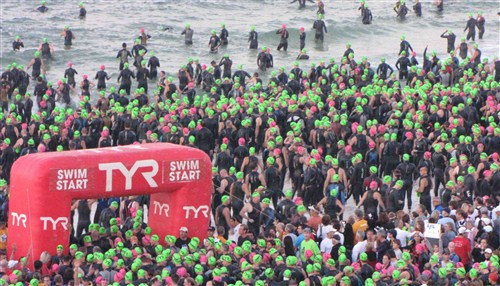
About 5 minutes into the swim I got kicked in the left hand. Yes, the left hand and my wedding ring fell right off to the bottom of the gulf. My wedding ring has only been off of my hand about 5 times in the last 10.5 yrs and now I had the next 10.5 hrs to think about it being missing. Many people have asked why I was even wearing it, but I have done at least 20 triathlons of various distances (including 2 previous Ironmans) with it on and have never had a problem… It is literally never off of my finger.
I made the turn buoy with no other issues but it felt like I was working much harder than usual. I made it back to shore to finish the first loop and prior to the race I had every intention of running on the beach. No way. I was a bit disoriented and dizzy from hard swimming in the waves and the sand was soft and it was super crowded. I crossed the timing mat and headed back towards the water. Entering the water was actually a bit difficult as the waves had gotten bigger and I had to fight my way through the breakers and the current. As I made it about half-way through the 2nd loop, swimming through all of the waves started to get me a bit seasick. To be clear, these weren’t, big monster waves, but they were just big enough that the constant up and down made me a little nauseous.
One nice thing about the mass start is that by time I got past the breakers on the 2nd loop, everybody around me was basically swimming the same pace as I was. I drafted where I could and didn’t have to sight much. As long as I could see swimmers to my left and to my right, I figured I was in the right place and didn’t worry much about proper sighting. Just after I made the final turn buoy to head back to shore I got kicked in the head. The kick wasn’t super hard, but hard enough to dislodge my goggles and let a bit of salt water into them. I stopped briefly to let the water out and fix them and was on my way again. During this last section, as I started to get bored of swimming, I started thinking about how salty my mouth tasted. I actually laughed thinking I wouldn’t need my first couple of salt pills on the bike because I already ingested enough salt the ‘natural’ way… I got into a little rhythm and then body surfed the last few waves before the shore and it was over. I limped up the shore and tried to keep my balance when I came to the wetsuit strippers. I laid down on the sand and he yanked off my wetsuit. A word of advice to those of you who might do this race in the future, skip the wetsuit strippers. It was nice to have it off quickly, but it sucked to be covered in sand for the rest of the day. If I could do it over again, I would wait until the change room to take off my wetsuit.
T1
Expected time: 9:00
Actual time: 5:44
289 Out of 2,582 (Top 11.2%)
I passed 117 people in T1
T1 at Florida is very long and looking at previous years results is why I expected around 9:00. You have to run up the beach and through an archway of the host hotel and into a parking lot to grab your gear bag. Then you run the length of the parking lot and into the hotel to the changing area. Then you change and run all the way back out and around the parking lot to grab your bike, then out to the mount line. All told, I would estimate 1/3 to 1/2 a mile of running in T1. Since I was a late entry into the race, I was bib number 3072. I think there were only 10 bib numbers higher than mine in the whole race. Therefore, my bags and my bike were always the furthest away possible… I must say, the volunteers in the change tent were awesome, I dumped my bag and the guy handed me things as I needed them, then as I ran out he put my wetsuit and other stuff back in my bag for me. I ran the whole time through transition and could tell I was passing a ton of people. I glanced at my watch just before I got to the bike mount line and saw 1:18:xx. I figured I had swum around a 1:10:00 and had about an 8 minute transition. Right on target…

Bike – 112 miles
Expected time: 5:15:xx-5:20:xx
Actual time: 5:04:40 (24 minute PR) – 22.1mph
198 out of 2,582 (Top 7.7%, compared to Top 7.8% at IMNYC)
Passed 369 people on the bike
Garmin File: http://connect.garmin.com/activity/240495130 (forgot to turn off until after race…)
Goal Normalized Power (NP): 200-205W
Actual Normalized Power: 193W
Intensity Factor: 66.8% (based on a 290W FTP)
Variability Index (VI): 1.04 (too high for this course, but lower than my 1.05 at IMNYC)
Training Stress Score (TSS): 225
I ride with an SRM crank based power meter, so throughout my recap, you will see very little about speed, because I only care about the amount of work I am putting into the pedals (power measured in Watts) and not how fast I am actually going. I was riding my brand new Cervelo P5 with electronic shifting, a Team ReserveAid disc cover on the back and a Zipp FC 808 front wheel. Basically it’s my dream bike with all the aerodynamic wizardry you could possibly have on a bike and I wanted to do it justice but also ride smart…
I hopped on my bike and shockingly had a hard time clipping in. Then I forgot to start my computer right away. But after that initial maintenance, I was off and on my way. I had never seen the course but knew it would be flat and fast as long as I rode smart. The first 7 miles takes you along Front Beach Road and as the name would imply, this was along the shore and the winds were a little gusty but nothing too crazy. I tried to “Just Ride Along” as EN prescribes to start the bike leg, but it’s not really in my nature to do that for very long. There were so many people heading out that it was like one big group and was hard to pass because of the congestion. Within a few miles I was dialed in close to my goal wattage and we were making the turn onto Highway 77. You read that right, most of this bike course was ridden right on the highway and the pavement was nice. There were no cones to separate the traffic from the riders, but there were no issues really. Traffic was light and generally stayed in the left lane as the cyclists stayed to the right. I was cruising along most of the time at 24-25mph…
I was passing a lot of people. When I passed, I always aimed right for their rear tire and passed at the last possible second. This course is all about aerodynamics and I tried to take any ‘legal’ draft I could throughout the day. I quickly realized how draft groups can form on this course. I was riding my race at my wattage, but there were 2-3 guys around me who were going about the same speed. I would pass them, then they would pass me. We were all making our way through traffic at a pretty good clip, but there always seemed to be the same couple people near me. When we got to the small bridge/overpass at about mile 12 this broke up a bit, I rode a little above my goal watts and everybody else stood up and hammered up the small hill as they blew by me. I flew down the other side of the overpass pedaling past everyone who was coasting.
At about mile 30 I noticed I was in a group of about 10 bikes. It was very hard to avoid. I was riding my Watts and as I would come up behind people, my Watts would go down. I would move to the left to pass and my watts would rise. I would usually make it past 3-4 people and instead of spiking my watts any further I would hop back into the middle of the group, wait for a minute or so, then head back to the left to pass 3-4 more people. When I made it to the front of the group it was always the same, I would keep my wattage dialed in as I rode in front for a minute or so, but inevitably someone would come by me, then another, then another… Once 5-6 people came by, I would get sick of it and move out and fight my way to the front again. This was a classic draft pack. It wasn’t pace lining as each bike was several bike lengths behind the one in front of them all “trying” to keep a legal distance, but I’m sure it was closer to drafting than not… I wasn’t trying to draft and I don’t think the others were trying to draft, it was just impossible to avoid. I decided to fall back and let it get away from me so I unzipped my bento box and took out a Powerbar and fought it open as many people passed me. I sat up and took a big bite, then another. The Powerbar was literally hanging out of my mouth as a race official rode up on a motorcycle and held up a red card and told me I had to stop at the next penalty box to serve a drafting penalty, then rode off. I was shocked. It was kind of like when everyone on the highway is driving along at 80 mph and you happen to be driving along at 75 mph in the middle of a big group but you are the one to get pulled over for speeding. Was I guilty of drafting? Probably… Was I less guilty than most of the people around me? I think so… I was eating a freakin’ Powerbar, clearly I wasn’t trying to suck the guy’s wheel in front of me. It doesn’t matter and this wasn’t a court of law. I had to simply continue on my way and try not to get penalized again.
In about 15 miles (mile marker 50 of the bike), I saw the dreaded yellow penalty tent… Arggggh! The penalty for drafting in an Ironman® is 4 minutes. But the actual time loss is much more. Here you are flying along at 25 mph, then you have to lose all of that momentum and get to 0 mph. Then you get to the tent and they hand you a stopwatch that they start and they tell you to let them know when you get close to 4 minutes. Then you have the shame of watching everyone else fly by you. I decided to try and make the best of my 4-minute ‘rest’. I ate my remaining Powerbar and finished my Infinit. You weren’t allowed to leave the small tent area to go to the bathroom, so I did what any good self-respecting triathlete would do and peed in my shorts and let it run down my leg and into my shoe. This is way, way worse than pee’ing on your bike because on your bike at least the 20+ mph wind blows the urine off your leg and into the abyss. When my 4 minutes was up, I was off and had to focus really hard on not drafting again.
The next 8 miles or so was an out-and-back on an old road with horribly cracked pavement. If you’ve never ridden a bike with tires pumped to 110psi at 22 mph over pavement with a bunch of cracks in it, this is what it feels like, “bump…………………Bump………….Bump..bump……………….bump…. ..bump..bump…Bump………………….Da dump………Bump….bump..”. I tried to dampen it a bit by riding on the painted white line, but the road was narrow and the line was 1 inch away from a several inch drop-off so one small mishap and I would be flipping over my handlebars. On second thought, maybe the bumps weren’t so bad considering this alternative.
I stopped at Bike Special Needs (BSN) with no issues. By time I pulled up to the very last box, a volunteer was already holding my BSN bag in his hand. I opened it up, grabbed my new slushy bottle of Infinit and my 2 new Powerbars and actually took the vented cover off of the front of my Rudy Project Wingspan helmet to let in more air. It was already getting very hot. I couldn’t have been stopped for more than 30 seconds and I was off again.
I tried to get the stupid drafting penalty out of my mind, but it was hard. On a 5-hour bike ride, there’s not all that much to think about. I was basically riding alone for the last 60 miles. I know this is a triathlon and you’re supposed to ride alone, but there is a mental benefit to having other fast people around you. I also kept wondering if my friend Paco (aka Carlo Portes) had made the swim cut-off, as that was his big hurdle in this race.
My lower stomach was feeling a bit weird, but I knew I needed to keep taking in calories. I just couldn’t imagine touching either of the 2 Powerbars that were in my bento box. I even considered stopping at a porta potty for a #2, but decided to suck it up until T2 to do this. I went to my trusty fallback and kept drinking my specially formulated Infinit mix, which was still cold for most of the race. All told, my nutrition on the bike was: 2 Powerbars, approx 1 bottle of Perform, and about 5-5.5 servings on Infinit for a total 2,050 calories (about 410/hr). I took about 3-4 salt sticks on the bike as well, so my total sodium intake on the bike was approximately 3,285 mg (~655 mg/hr).
With about 20 miles to go, a guy who I had been leap-frogging with for a while turned to me and said “are you with Endurance Nation (EN)”? I got a big smile and said yes so we introduced ourselves. His name was Sukhi and I recognized it right away after having communicated with him in the EN forums for the last 6 months. He said he had been in a dark place for a while, but I reminded him that the bike was almost over and that he was a ridiculous good runner, which seemed to perk him up a bit (Sukhi went on to run a 3:27 marathon…). It was nice to see a Teammate on the course after so long…
After moving on, I faced the hardest part of the bike… The last 15 miles or so were into a headwind and I found myself mostly alone again. There were a handful of people around me and I imagined we were pro’s in Kona because we were all pretty evenly and legally spaced out, we all had our heads down and simply tried to stay as low as possible to stay under the wind. We didn’t really say anything or acknowledge those around us; we just kept pedaling. My power was still pretty steady, but because of the headwind I had slowed dramatically to around 19mph or so…
The Florida bike course is fast, but it is far from easy. I actually found it much harder than the IMNYC or IMLou bike courses. I had to stretch my shoulders and arms a few times and because being locked in the aerobars for 5 hours straight is just plain hard. I also expected to ride a very steady bike leg with no power surges (usually your power surges and falls off on hilly courses) but what I found was all of the groups of people made it hard to ride steady. You would need to spike your power to pass, and it would come down if you were passed or stuck in traffic. There were also a few hills that were just big enough to cause damage if you weren’t careful (my Garmin showed 1,700′ of elevation change for the 112 miles). I kept hearing my EN coaches in my head telling me not to spike my power to pass, but I also didn’t want to be penalized for drafting again, so there were several occasions where I knew I was ‘burning matches’ in my legs but made the executive decision to do so and had to live with those decisions later… All in all, I rode at a NP that was 4W lower than what I did at IMNYC and I had a 1% lower VI, but my quads were hurting much worse as I was exiting the bike.
T2
Expected time: 5:00
Actual time: 3:23
261 out of 2,582 (Top 10.1%)
Passed 6 people in T2
I took my feet out of my bike shoes at the last minute before I got to the dismount line. So as soon as I got off my bike, I handed it off to a Volunteer and ran bare-footed into the gear bag area. As soon as I entered the room, I was greeted with a loud scream of “WITHROW”! My friend Tovah who was acting as my #2 Sherpa for the weekend had landed a volunteer spot in the gear bag area. She said, “Jess has your bag, good luck”… I literally sprinted diagonally across the room hurdling over the rows of bags to arrive in the far back corner of the room where I knew my bag was. There was my wife Jess who I apparently caught by surprise. I looked at her asking for my bag and when she held it up, there was no orange or green tape on it… Not my bag! doh! I frantically checked the pile for my bag and she found it for me and I grabbed it and was off to the change area in a flash. So much for the romantic embrace… The volunteer in the changing area was awesome. He handed me my stuff as I needed it and offered to put my bike stuff into my bag for me. For the first time in a race, I changed my shorts into a new pair for the run. This took less than 10 seconds and was time well spent. I flew out of the changing area, got a quick dab of sunscreen from the appliers and was off. I skipped the porta-potty even though my stomach was calling me to it still.
Run – 26.2 miles
Expected time: 4:15-4:20 (but I expected mid-70’s temps, not high-80’s)
Actual time: 4:25:46 (11 min PR)
VDOT: 46
567 out of 2,582 (Top 22.0%, 8.3% better than IMNYC)
Garmin File: http://connect.garmin.com/activity/240488099
When I started the run, my quads hurt… Bad…. I knew I had to keep good running form. High turnover, stand tall, use my glutes, use my glutes, use my glutes… My plan was to try to run about 9:00 miles and slow through every aid station giving me a total per mile of low to mid 9’s. I was not going to be a slave to my Garmin and planned to run mostly by feel. My main goal was to not blow up like in IMNYC. I knew I had to stay on top of my nutrition and be much more self-aware. I guess now I can also tell you about my “One Thing”. In the month or so leading up to this race, I told everyone who would listen that my goal for this race was to have a 10-handle. 10:59:59 or better. If it was going to be close I would run at whatever pace as necessary to get a 10-handle and if that caused me to blow up and walk the last 5-10 miles I was okay with that outcome. Many people thought I was crazy to think someone as slow as me could go sub-11, but those who knew me the best wouldn’t bet against me…
One thing I am good at is doing math in my head. I was wearing 2 watches; I had a Garmin 310xt on my left wrist that I started at the beginning of the run and I also had a simple Timex Ironman® on my right wrist that I had started at the beginnings of the race. My Timex read 6:27:xx when I started the run. I had 4:33:xx to run an Ironman® marathon… “I got this”… I did a 4:38 marathon at IMLou and I am in much better shape now. I knew I was certainly capable of a 4:15 marathon and deep down in the back of my head I secretly though I might even be capable of coming close to 4hrs… “don’t screw it up, Withrow!”
I started out as I had originally planned and ticked off the first mile around 9 minutes. I hit the aid station and put ice in my cool wings, dumped ice water over my head and took a small drink of perform which I chased with a drink of water. Mile 2 was similar to mile 1 so I took a swig of my Infinit Napalm before the aid station. I grabbed a banana and some water, more ice and was off. Just when I thought I might actually be able to do that 24 more times in a row I realized that I was actually running on the surface if the sun! It was so hot. It was actually 88 degrees and rising when I started the run (according to my Garmin Bike Computer) and it was humid. The pain in my quads had numbed a bit, so now instead of the feeling that my quads were stuck in a hydraulic vice, they simply felt like there were a dozen ice picks shoved into each quad… At least that is tolerable…
After mile 2, I settled in to a mid-9’s running pace and tried to focus the aid stations on staying cool and wet with lots of ice and by dumping water on myself. I kept telling myself to take in calories. My stomach still hurt a bit, but I found a scary but good solution. I farted… Yup, sounds simple, right? Well it’s not. Try farting while running a 9:30 mile when you’re already 7 hours into a tough day, your stomach is cramped and you’re soaked from heart to toe… A little leaked out between strides for about 5-6 steps like I was a sputtering moped. It was scary because I wasn’t 100% sure that air would be the only thing to come out. Luckily it was, which only emboldened me to try again. So every mile or two for the next 20 miles I let one sputter out which made me feel a little less stomach pressure with each one. I know it’s gross, but it actually made me laugh to myself every time. On one of my put-put-puuuuuuut occasions I happened to be running next to a dude with an Aussie accent. He laughed and said to me “whoa mate, you’re a brave dude… I wish I had the confidence to do that right now. Right on man!” And such is the life of an Ironman!
I got a little boost around mile 5.5 when I saw my coaches Rich and Patrick (RnP) from Endurance Nation just before I entered into the Park area… I first saw the EN flag and it was a good queue to remember to look strong. Head up, solid hips, high cadence… Sorry RnP, that’s all I had the capacity to think about at that point, no smile for you… They lied and told me I looked strong. This good form and strong running stayed with me for at least a half a mile, which was awesome… On the way out of the park at around mile 8 I saw them again and Coach P gave me something to think about for, oh, the next 3 hours… He said “Withrow, if you don’t go sub-10 I get to keep your bike!”. Instantly my mind was humming. Did he know I had been doing the math every mile for the last hour on what it would take to finish with a 10-handle on the clock? Surely he meant 10-handle, and not sub-10. Maybe they use a different lingo in Rhode Island… Oh well, I will assume he meant “10-handle” and there’s no way that dude is getting my bike! (side note: I talked to Coach P after the race and he said he had no idea what pace I was on or what my goal was for the race, he just wanted to come up with something quick and witty on the spot to motivate me… He had no idea that he had chosen EXACTLY the right phrase for me at that moment in time.
Now I had something to add in to what was running through my brain for those 10-minute stints between aid stations. If you’re wondering what one actually thinks about between hours 6:30-10:52 of an Ironman, here’s what goes through my mind (over and over again 26 times) after I leave an aid station:
0-30s: maintain good form, high cadence, let my watch find my proper moving pace, x miles down, glance at watch, confirm current pace, confirm cadence, run with glutes, run tall, breathe
30s-2min: math time – calculating things like how many miles I have left (to the decimal), the exact pace (to the second) I need to average to finish those remaining miles under my goal. The exact time I would finish if I kept running the same pace I was currently running, the delta between those two paces, how much of that delta I want to spend on the next aid station to ensure no blow ups
2min-9.5 mins: counting – “1 step step step, 2 step step step, 3 step step step…” I start over when I get to 100 or when I lose track. Lots and lots of counting…
9.5min-10min: self assess- how do I feel, am I dizzy, do I need salt, what nutrition do I need/want, do I need to hydrate, how hot am I
Then I get to the aid station and repeat. The nice thing about Coach P’s comment was that it gave me something to think about in the beginning of that block of counting. It was a nice thing to add right after I did my math and knew there was no way I was going to finish without a 10-handle.
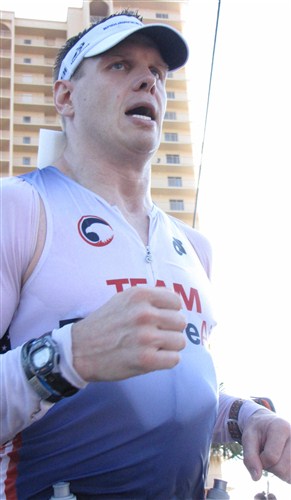
I got another little pick me up around mile 12 when Tovah was screaming my name from the side of the road. I glanced ahead and saw Jess in full-on photographer pose ready to capture my moment. Best Sherpa ever! But below is the picture she took… As you can see my face is already pale and my mouth is hanging open to suck in every extra molecule of oxygen possible. You can also see the cooling sponges behind my neck and down under my kit in the front. Remember I still had 14 miles to run at this point. One thing is for sure; I have rarely been accused of not putting my game face on and giving it all I have.
Getting my special needs bag around mile 13 went off without a hitch. I stopped at the last volunteer who was already holding my bag up and open for me, swapped my Napalm flasks for new ones and was off in no time. I thought I would see Tovah and Jess again on the way out but must have missed them. The second loop of the run course was fairly uneventful. The same things kept going through my head and I just continued to tick off the miles. I saw coaches RnP again at mile 18 “The Line” and again at mile 21.
Looking at my run splits throughout the day, it appears as though I was fading throughout the run. My official splits gradually climb from around 10:00 per mile at mile 6 to around 10:30 per mile near the end. The real story is that my “moving” running pace was surprisingly stead from miles 6-26… I was ran almost every one of those miles between 9:45 and 10:00 pace, but most were within 5 seconds of 9:55 pace. So if looking at my run splits tells a different story, what gives? Forced self awareness…
Flashback: At IMNYC 3 months earlier, I also felt pretty good. I was slogging out 10-minute miles on what I would consider a much tougher run course. They lost my RSN bag, which contained my 2nd half of run nutrition. I didn’t adjust on the fly and paid for it dearly. I didn’t pay close enough attention to my body and ran a whole bunch of 10 min miles and then blew up completely and was stopped in my tracks at mile 23 without any warning that I was aware of. I had committed to myself that I would learn from that experience and not allow that to happen in this race.
Sooooo. As I was ticking off my 10 min miles and doing all of my math I knew I would break 11 hours with plenty of time to spare even if I slowed down. But I didn’t need to slow down. As long as I kept telling my quads to shut up I could keep running at this pace. The thing I did differently this time was to make a very deliberate decision to start taking more time in the aid stations. Early on this meant slowing down more to take in nutrition. And each mile that I ticked off, I deliberately took a little more and more time in the aid stations. At say mile 16 this meant I could walk more steps to get a drink of coke and get ice into my cool wings. At say mile 20 this meant to physically stop for a second to drink a coke, then walk to the water person and stop to drink that. By say mile 23 I would stop, drink a half a cup of coke, then walk a bit, then stop and drink a few swigs of Perform, then walk as I got a drink of water, then walk for a few seconds while I grabbed a cup of ice and dumped it into my hands to carry for a while as I then started to run again. These aid stations probably added about 5 seconds to my mile splits at mile 6, 15 seconds per mile split at mile 16 and almost 30 seconds per mile at mile 23+. Could I have finished 5 minutes faster without all of these aid station breaks? Probably… But stubbornly running full bore ahead without regard to anything else would have exponentially increased my risk of “blowing up” and I refused to do that given that my “One Thing” was to break 11 hours and that was so firmly within my grasp that greed and stubbornness was not going to take that away from me!
I have never had the opportunity to enjoy an Ironman® finish line. At IMLou I thought it was cool, but I was so focused on getting to that finish line for the first time that I didn’t high-five anyone or even smile. At IMNYC I was practically comatose and don’t even remember the finishing chute or the finish line or the last whole mile for that matter. I had planned this time to be different, since I had almost 8 minutes to spare and I actually was still with it mentally and other than my quads I actually didn’t feel horrible. So I was going to soak it in. Ham it up with the spectators, give plenty of high-fives and be sure to give the EN gang sign at the finish…
Flashback 4 months- when I decided to race IMFL, it was already sold out so I tried to get in through the Ironman® Executive Challenge (XC). This is a VIP program that is fantastically overpriced, but also gives 2 Kona Slots (KQ) to the best of the 15 or so people who are racing through that program… In 2010, the winner of the KQ slot in my age-group did so with an 11:02 time. I didn’t actually enter through the XC, but got my slot through EST instead…
So there I was a couple of hundred yds from the finish line… I had already zipped up my kit top, and was preparing for my “ham it up” session to begin when a dude wearing an Ironman® XC kit passed me! Wha wha whaaaat? Was this the dude that was going to get a Kona slot through the sold-out XC program that I was too late to sign up for? If he got that slot and he beat me, then that would mean that even if I had done the XC I wouldn’t have gotten the slot anyways. I thought all of those things in about a millisecond and something snapped inside my oxygen depleted brain and I started sprinting. I know it was stupid because it had no meaning whatsoever. Even if I did beat him to the line, there was no KQ slot for me and this poor guy didn’t even know that I was racing him! I weaved through the people in the finishing chute and at a full sprint, passed the guy and crossed the finish line beating him by 3 seconds. I was totally winded, but I had done it, I had beaten the guy in the XC kit.
Wait!!! Crap!!!!! What about the Ironman® finish? Doh! Withrow, you idiot! You didn’t hear your name called, you didn’t smile, you didn’t high-five any spectators… You just raced some unnamed dude in an XC kit (that didn’t know he was racing you) for 200yds for no reason in the last 200yds of a 140.6 mile race. But damn it felt good to beat him!!
Post race
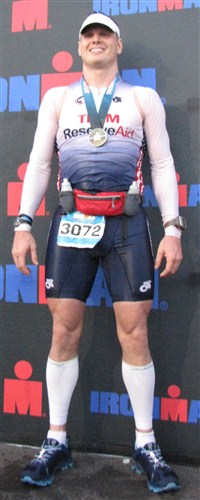
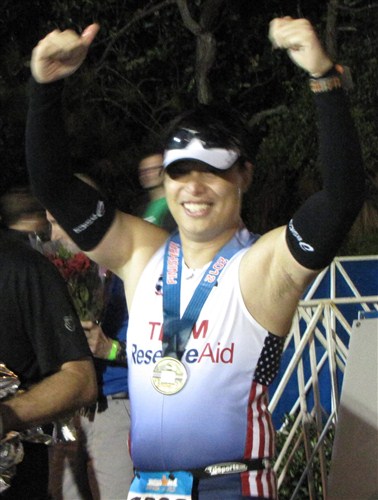
Ironman® finishes are actually really cool. There is a volunteer at the finish line to ‘catch’ every finisher as they come across the line. They are awesome! They hold you up, help you get your medal and take your timing chip off (because it’s impossible to bend over to get to your ankle at that point of the day), they get you one of those cool Mylar warming blankets, get your finishers hat and T-shirt for you and walk you to the finisher’s photo area. The final thing they usually do for me after a race is carry me to the med tent. This finish was even better because Jess was also there in her volunteer shirt. She congratulated me and walked with us through the post-race finisher’s chute area for all of the things I just mentioned. I was particularly winded because, well, I’m an idiot who just did a 200 yd sprint, but other than that and my quads, I felt actually felt ‘not terrible’. (btw, you can see how swollen my quads are in my finisher’s picture Jess took below. No, I am not flexing them in this picture…)
So after I got my picture taken, Jess turned to the catcher and this was the conversation that ensued:
Jess: “Can you take him to the med tent now?”
Catcher: “No problem it’s right this way”
Jess: “Cool, thanks”
Me: “I don’t think I need to go to the med tent”
Jess: “You definitely need to go to the med tent”
Catcher: “Do you need to go to the med tent, I’m happy to take you there”
Jess: “He always goes to the med tent after an Ironman”
Me: “I actually don’t feel that bad and I don’t need to go to the med tent”
Jess: “You look really bad and you definitely need to go to the med tent”
Me: “Jess, you have clearly never seen me after a race before, trust me, I feel pretty good, I REALLY do not need to go to the med tent”
Jess: “You are so stubborn sometimes! Are you sure?”
Me: “I’m sure.”
Jess: “C’mon… Are you serious? You’re sure?”
Me: “I’m sure…”
Catcher: “If you change your mind, it’s right over there…”
Me: “Where can I get a slice of pizza?”
I got a couple of slices of pizza and a few Dixie cups full of the best generic plain potato chips I have ever had in my whole entire life, and limped up to my friend Paco’s hotel room which was right near the finish line. I showered and put on my compression pants and a clean set of clothes. Jess and Tovah were awesome in that they went and got all of mine and Paco’s gear bags and washed out our wetsuits in the bathtub. Tovah even walked to RSN and sweet talked them into giving her my RSN bag so I wouldn’t lose my Napalm gel flasks… The best Sherpas EVER!!!
We hung out by the finish line for a while then went to Mellow Mushroom to meet up with Coaches RnP and several other EN team members. I kept checking the live race day tracker to see how Paco was doing. My math skills are pretty good, but my brain was starting to turn to mush at this point. Coach Rich asked me about Paco’s mindset and if I thought he was aware of the 17 hr cut-off and of what he would need to do to finish on time. I told him that Paco was cut from the same cloth as me and I’m positive he had done the math and knew exactly how fast he needed to be moving to finish on time. But something deep in my gut was unsettling. I had calculated that he would finish right around 11:30 PM and have about a half hour to spare, but what if his watch had run out of battery power, or he had an injury, or maybe he was delirious out on the course somewhere…? The food hadn’t showed up yet when I told Jess I was going to go and find Paco. We got into a small argument that was basically the opposite of every argument we have ever had… She was right based on a totally rational set of facts and I was totally irrational but won. Her argument was that Paco surely knew exactly how much time he had to finish, it was an individual race, and he had more than a half hour to spare, not to mention that Jess had a broken foot and I had just done a freakin’ Ironman. My argument was that I was worried about him, I had convinced him to do the Ironman® and if he missed the cut-off by 1 minute because I was too lazy to go motivate him then I would never forgive myself.
Jess and I left the bar just after the food arrived with many eye-rolls from the other ENers there who obviously knew that I had lost my marbles… We started walking the course backwards to find Paco. After almost 45 minutes of walking we started to wonder if we had missed him and Jess reminded me that it would be a very long walk back by ourselves, and that he might have already finished the race… I did some quick math and reluctantly agreed that if we didn’t see him within 7 minutes that we would stop walking, turn around and head back. Sure enough, 5 minutes later we saw him. We had walked about 3 miles in total to that point. I think I was happier to see him than he was to see me… He was certainly surprised to see me. He was walking with a friend he had made. He explained that his calves had totally seized up around mile 10 and that he had hobbled the last 13 or so miles. He showed a ton of guts on the day and it was fun to walk it in with him sharing war stories from the day.
Jess and I took a short cut right near the end so we were able to watch him cross the finish line to become an Ironman® in 16:24:xx! We then stuck around to watch the final finishers before midnight amidst a ton of noise and excitement. Jess was even kind enough to drive out of our way on the way home to get me a Wendy’s Spicy Chicken sandwich and a Frosty before heading back to the condo…
Summary: Before this race I thought Florida would be ‘less hard’ than my other 2 Ironmans. Nothing could be farther from the truth. The swim was difficult with the currents, waves, and mosh pit start. The bike course may have been fast, but even though I had ridden at 4W lower than IMNYC, the constant pedaling and lack of position and cadence changes thrashed my quads much more than IMLou or IMNYC. And the run may have been flat, but it was hot and humid and anything but easy! All in all, I achieved my “One thing” for the race…
My “One thing” for my next 6 months of training will be to convert myself into a Runner; I have obvious gains to be made there if I work smart and hard. And I’m planting my flag in the sand publicly right now, my goal for IM Lake Placid next summer is at least a 10min PR over Florida on a much hillier course!
Acknowledgements:
There are so many people I need to thank that there is no way this list can be all inclusive but I’ll at least hit a few:
Jess for always supporting my craziness and being the best-est Sherpa ever!
My parents for watching my kids while we were at the race and for much of my training
Team ReserveAid – Great Charity, Great Team, Great People! Tri for our Troops! www.reserveaid.org/TeamRA
Endurance Nation for guiding my Ironman® training (including Coaches RnP and all of the members of the team for their guidance and support) www.endurancenation.us/
Pursuit Athletic Performance for giving me the tools I need to fix my run gait. http://pursuitathleticperformance.com/
High Gear Cyclery for hooking me up with the best bike on the planet and for their constant bike maintenance and support.http://www.highgearcyclery.com/
The Macquarie Group Foundation for continued financial support of ReserveAid.
Paco for giving me a reason to do IMFL, and for showing me that heart and desire trumps everything else if you really want to do something!
Tovah, AKA The Mini Ninja, for being the 2nd best Sherpa ever!

Leave a Reply