Fatigue, FTP, & Your Final Weeks

Posted by admin On July - 5 - 2011

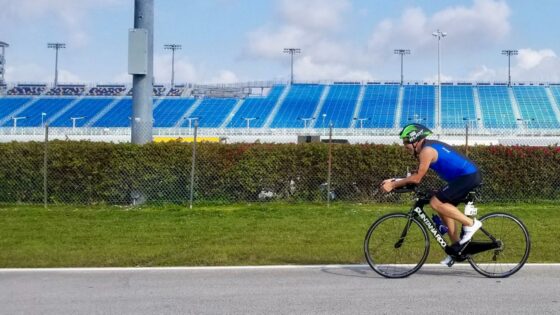
Cervelo P2It sure looks fast…now how will you ride it?
Creative Commons License photo credit: Alex Kehr


There are two very important questions that you, as an Ironman athlete, have to be ready to answer about your bike fitness heading into the final eight weeks of your Ironman or Half Ironman training cycle. First you have to know what your Functional Threshold Power (link?) is, or at least the Heart Rate equivalent. Second, you have to be able to give a resounding “YES!” answer as to whether or not you have done all of your bike workouts, especially the longer sessions.

In other words, successful race prep is about knowing your limits (your power/HR numbers) and about having confidence in your strengths. If you fudge either of these factors on your way to Race Day, your overall performance will suffer and you won’t be able to race to your potential.

The closer you get to the Big Day, however, the harder these two questions become to answer. Cumulative fatigue mounts, and your ability to generate or even sustain threshold effort on the bike becomes severely compromised. This can lead you to question your fitness and overall preparedness, and perhaps even to make some rash decisions.

An Example Situation

I have this “friend” who is training for Ironman Lake Placid 2011. His name is Patrick, and he’s a coach with Endurance Nation. Really nice guy…and here’s his FTP dilemma. It’s a story repeated across athletes and seasons; maybe it’s even happened to you.

Back in February, his FTP tested out at 342 on the indoor trainer, putting his estimated outdoor watts pretty close to 360.

When he got outside on his road bike in April, he spent four weeks chasing that estimated outdoor FTP before he acknowledged that the single test he took must have been an outlier. He dials his FTP back down to 342.

At the end of May, Patrick busts out his Tri Bike and notices right away that he can’t generate the same high numbers in the aero position, so he dials the watts down to 330.

And now with just three weeks to go, with some epic long rides and lots of long runs on his legs, Patrick is having trouble even hitting 330…it’s more like 320.

Is Patrick in trouble? Has he been getting less and less fit all year long? Has his entire season been a waste since that one test in February? The answer is no, across the board, and here’s why Patrick remains confident heading into his biggest race of the season.

Volume vs Intensity Inside EN

Volume gets a bad rap inside Endurance Nation, at least on the surface. We prefer to use intensity to create training stress, as it’s a much more time-effective method. As such, our OutSeason training includes lots of intervals and, commensurately, lots of rest. This is why back in February, Patrick and many other EN athletes were posting life best numbers.

As the weather turns and we move outdoors, the nature of our regular rides changes significantly. While the intervals remain an important component, the overall volume of almost every session is lengthened. Instead of doing 90 minutes of interval work on the bike across four total hours of riding, EN athletes will do that same 90 minutes across six or even eight hours on the bike.

This ratio continues to decrease the closer you get to your big race, as the long rides for an Ironman can mean a week of cycling nine hours. And that doesn’t take into account if you have added a Big Bike Weekend or Week into your season, like Patrick did back in May when he put in over 600 miles in nine days.

FTP Down but Race Fitness Up

At the end of the day, how we train is a function of the principle of specificity. In the Winter months, with no long race on the calendar, we can do a great deal of high intensity training to improve the upper limits of our bike and run fitness. As we move into the season and approach our Half or Ironman event, the mileage increases to prepare us for the rigors of the day.

While Patrick’s FTP appears to be on a downward trend, the simple truth is that he has been manipulating Training Stress by adding more time at a lower, race specific intensity. This is in stark contrast to the Winter training with it’s 8-, 12-, and 20-minute interval repeats.

Here is a good example of how this situation plays out. On Wednesday, Patrick can’t hit his current FTP of 330 during the mid-week interval session, turning in intervals in the 90% to 92% range (instead of the preferred 95-100% range). On Saturday he ride 150 miles at 74.5% of his FTP, — significantly higher that he had estimated. So while the high-end fitness isn’t necessarily there, it’s easy to see how the Winter strength has transformed into race-specific endurance.

Zen and the Art of Training for the Final Eight Weeks

While our Triathlon Training Plans include interval sessions and at least one bike and run fitness test, your top priorities lie elsewhere. With the shift to Race Prep training in the last twelve weeks / three months of your plan, your focus should also move from a quantitative obsession with bike and run threshold numbers.

You top goal for the final eight weeks is to remain healthy — so recover well and get lots of sleep. You need to be consistent with your sessions — so manage your effort every day so you can hit the workouts as written for each consecutive day. In other words, no hero sessions that set you back for a few days…please!

Your mental focus is on riding and running as steadily as possible, and you should be constantly testing your race fit and gear for the bike.  Every long ride is a chance to see how your bike position feels, how your clothing choice works, whether or not your nutrition is effective, etc. Race Day is about Execution, Not Fitness — the bike and run courses don’t care what your FTP is…they only care how well you ride them.

Inside Endurance Nation, we put your fitness and execution to the test in the form of two Race Simulation workouts. These are a 112-mile bike (or 6 hours, whichever comes first) followed by a 6-mile run (or 1 hour, whichever comes first).  Most likely these workouts will be full of challenges. Not to worry as all these issues will ensure you are fit and ready to go come race day.

Determining Your FTP Pre-Race

Just because coming by an FTP isn’t easy, doesn’t mean you can avoid it. It’s one of the most important metrics you need heading into the race so you can dial in the appropriate race effort that will set up a solid run.

While your first option is to complete another functional threshold test, the odds of you putting out a test indicative of your current fitness levels is pretty slim. It could be good, or it could be the double whammy that hurts your ego (another low number!) and messes up your race calculations.

Your second option is to review the data for the last month and make an educated guess. By using something like Training Peaks WKO to review the power output for the last 30 days, you can accurately find where you have spent the majority of your time riding. You can ballpark your FTP by looking on the right side of the bell curve, as the bars start to drop down…the biggest incremental fall off in 10 watt increments is a good indicator of where your fitness moves from aerobic/sustainable to anaerobic/unsustainable.

Final Bike Thoughts

Your fitness will be what it will be on race day; it’s not how strong you are on race day but rather how you use that strength. Rest assured that as an Endurance Nation member or training plan athlete, you have done all the hard work required to get stronger.

Instead of stressing about the final few watts or pounds, put your focus and attention to nailing the intangibles. Between dialing in your bike fit (see Todd at TTBikeFit.com), good bike setup, smart gearing choices, and how to ride steady/smart, EN athletes get a lot of free speed and smart riding mojo on race day. If your worried that you won’t be as strong as you’d like, then take comfort in knowing that you’ll be more aero, better geared and much, much smarter.

Good luck!

Popularity: 15% [?]

Ironman Coach Q&A Session #3: The 360-Degree Pedal Stroke

Posted by admin On June - 16 - 2010

We get email and Twitter questions regarding our training plans all the time. We strive to answer each one, and it occurred to us that maybe sharing this information could be good for other self-coached triathletes out there. Enjoy!

Rich and Patrick


Looking for info on pedal stroke technique. ½ iron athlete and have always kept an even down/up power stroke and sliding across top/bottom of the stroke. Trying to keep circles but seems something is missing. Seems that there would be a hole in the power in  the top/bottom…Any references / thoughts/ suggestions ???
Thanks!
Ron


Ron, there are tons of great resources out there on proper pedaling techniques and drills. A quick search of YouTube should give you more than enough fodder. The particular deadspot you are talking of is pretty common for triathletes, especially in the aero position. Good on you for noting it’s top and bottom…most only notice it on the bottom side. These folks are forgetting that the cranks are fixed, and that your ability to pull through the bottom of the stroke is only as good as your ability to push the other foot over the top of the other side!

This could be a flexibility or strength related issue (or a combination). I suggest two approaches.

#1, work on hip flexor flexibility. Consider doing some lunge stretches, where you really push your hips forward to open them up. Perhaps even consider arching backwards to really do a number on your hips. You can also do this as you stretch your quad on that side. Holding your heel to your butt, stand erect and push that hip forward as you hold the stretch. You’ll feel it!

#2, work on strengthening the area. The hip flexors and psoas muscles can be a bit weak and fatigue easily, especially if they are tight. Once you have started stretching, consider adding in some cycling-specific strength work. I prefer to do single leg pedaling while on a trainer at about 60-70 rpms. Load the wheel up to the point where you really need to slow down – but not so hard so as to put undue strain on your body. Work on a smooth transition from 10 o’clock to 2 o’clock. As you build up confidence and skill, add more speed (less resistance). Do this each leg for 45-60 seconds, alternating sides. So six minutes of that plus 4 minutes of regular pedaling with both legs as recovery, done a few times a week, should help you out!

Keep us posted!

Popularity: 27% [?]

TOC Camp Stage 7: LA Time Trial

Posted by admin On June - 12 - 2010

Jens, the patron saint of Work WORKS!!

Theme of the Day: We can rest…FINALLY!!!

Summary: We sleep in, pack the bikes, watch the TT downtown and take WAY too many pictures of pro’s and sweet bikes!

The Full Run Down
6 days, over 25hrs, and nearly 400 miles of riding and we are DONE!! Time to rest and watch the pro’s take on the mean streets of Los Angeles for the time trial stage!

Though he has the day off, Riley assumes his post as Camp Mascot

Sonny tries to stowaway in a camper bike box

A Schleck, in need of a sammich

Spartacus!

George warms up

Mo' Jens is always Mo' Betta'

Chrissie sighting, after her TT on the course before the race

Camper Chris (HED hat) scores a spot IN the start house!

Trent scores a spot ON the TT announcer's platform!

Chris Horner

The Laydeez compare pro tour boyfriend pics over beers at the Yardhouse

The Endurance Nation Tour of California is a members-only event. Please join our waiting list to receive an invitation to join TeamEN as space becomes available.

Popularity: 8% [?]

TOC Camp Stage 6: Palmdale to Big Bear

Posted by admin On June - 11 - 2010

Theme of the Day: “I think I may have undersold this stage…” — Coach Rich

Summary: We insert ourselves into about mile 85 of Stage 6, still good enough for more than solid mileage and climbing. The campers witness the first mountain top finish in ToC history.

The Full Run Down
After 3 years of doing the ToC camp, we know that everyone is pretty well trashed by Thursday, just in time for an easy day and pastries in Solvang before another solid day on Saturday. But not this year! Stage 6 is in Coach Rich’s backyard. He rides the San Gabriel mountains regularly and the thought of riding the complete stage, from Palmdale to Big Bear…just crazy!

So we exercised the Local Knowledge Card and inserted the campers just beyond where the course intersected Interstate 15 in the Cajon Pass, and pointed them east (and up, up, up) to Big Bear, including a VERY steep KOM outside Crestline followed quickly by an intermediate sprint…with an evil little 18% kicker in the last 200m…ugggg!!!

The campers continued onwards on Hwy 18 to Big Bear, some following the ToC course along the north shore of the lake, other opting for the more direct south shore. Everyone made it to town with plenty of time to enjoy a sandwich and watch the finish: 800-1000m at 3-4%. The lead group of about 30 riders were seriously hurting up this grind.

Dinner at Rich’s house in Monrovia featured kabobs, beer, wine, and a week’s worth of tall tales and memories shared around the fire.

Coach Rich's briefs the campers before Stage 6

Hwy 18, Rim of the World Highway

Levi grinds it in with the lead group

Good times and smack around the fire

The Endurance Nation Tour of California is a members-only event. Please join our waiting list to receive an invitation to join TeamEN as space becomes available.

Popularity: 7% [?]

TOC Camp Stage 5: Visalia to Bakersfield

Posted by admin On June - 10 - 2010

The riding does not suck in California

Theme of the Day: Yeah, no, this stage is boring….let’s do something epically cool!

Summary: Coach Rich leverages his knowledge of California’s best roads to create a custom stage — a climb through Sequoia National Forest, max elevation of 7300 feet, then a descent down the Kern River to a sprint finish just outside Kernville!

The Full Run Down: It seems that most years the Tour includes a stage that is less than exciting, meant to put in the miles between points A and B. Last year it was a mostly flat and windy stage across the Central Valley…which we skipped, opting instead to ride through Fort Hunter Liggett to the coast and back, one of the most scenic rides in California. This year it was Stage 5 from Visalia to Bakersfield. A little weary of the time pressure of being chased by the Tour and so close to the Sierras and epic riding, we pulled ourselves off the course and rode through Sequoia National Forest to Kernville instead!

The plan was simple: drive out of Visalia and into the mountains until the GPS said we were at about 3500ft elevation. Jump out of the vans and climb south on Hwy 190 and the Western Divide Hwy through Sequoia National Forest, over 7300ft elevation and through the Trail of 100 Giants. Descend down to the Kern River and finish up in Kernville before our drive to Monrovia, Rich’s home outside LA.

The ride, the scenery, and the relaxed timeline of the day was just what we needed to recharge our heads, if not our legs. The campers still got in X and Y, but the views were worth the work. The A-Group had fun attacking each other into the wind on the run into Kernville before an impromptu final sprint before the vans, which were conveniently staged at a general store offering tri-tip sammiches, milkshakes, and the Tour live on TV!

Coach Rich, after having cycled and moto’ed much of central and southern California, from SanFran to San Diego, declared this to be the BEST ride he has ever done. Period. Enjoy the pictures below!

Stage 5, DIY, Map and Profile on MapMyRide.com

Stage 5 Pictures and Video

Nemo, INSIDE a tree on the Trail of 100 Giants

More fun with ludicrous big trees...

Dan Socie, Coach Rich, and Trent "Drillbit" Prough at a roadside waterfall, elevation ~7k feet.

Sequoia National Forest, 7k feet elevation, and the road to ourselves!

Quick regroup on Western Divide Hwy before the descent to the Kern river

Waterfall, upper Kern River

Campers watch the final minutes of Stage 5, live, while enjoying tri-tip and shakes

The Endurance Nation Tour of California is a members-only event. Please join our waiting list to receive an invitation to join TeamEN as space becomes available.

Popularity: 8% [?]